Content Feed

Discover interesting content about books and writing

Tip May 23, 11:46 AM

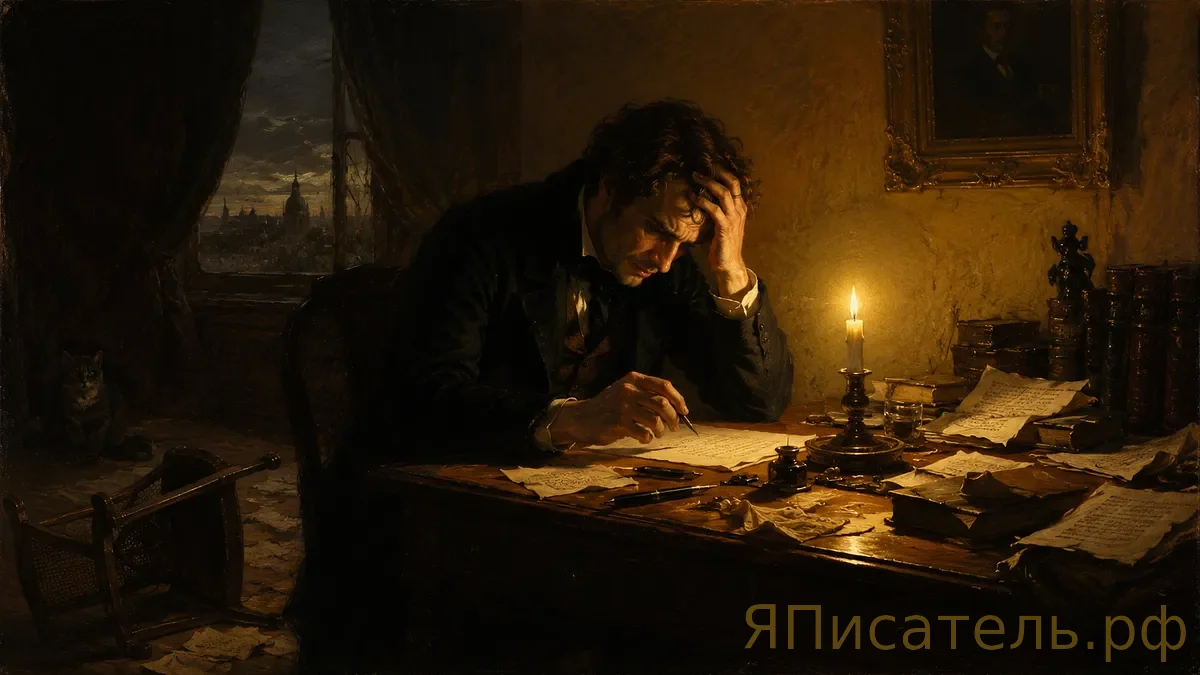
Show Don't Tell Principle
Show Don't Tell Principle

Understand how Russian writers reveal character and emotion through action, sensation, and detail rather than direct statement. The principle of showing creates immersive experiences that allow readers to draw their own conclusions.

The dictum 'show don't tell' remains fundamental to Russian literary tradition, where writers believed readers should experience scenes rather than hear authorial commentary. Instead of stating 'Ivan was angry,' Russian prose demonstrates anger through clenched fists, rapid speech, broken objects, or calculated coldness. Tolstoy exemplified this approach, using physical detail to convey emotional states: a character's hand trembling reveals anxiety more powerfully than declaring anxiety. The technique extends beyond emotion to all abstract concepts—justice, love, betrayal, faith. Rather than philosophizing about human nature, Russian writers constructed scenes where readers witness nature through specific, sensory details. This requires precision: the right detail carries enormous weight. A character adjusting their collar reveals self-consciousness; a hesitation before speech suggests doubt. Russian prose avoids telling readers what to think or feel about characters, trusting instead in the power of carefully selected action and detail. The reader becomes an active participant, interpreting behavior and drawing conclusions. This approach makes stories memorable because readers feel they've discovered truths themselves rather than being instructed.

Tip Feb 14, 04:01 PM

The Wrong Comfort: Let Characters Soothe Others With What They Need to Hear Themselves

When a character comforts someone, have them unknowingly deliver the exact advice they themselves need but refuse to follow. A mother reassuring her son 'it's okay to let people go' while hoarding every letter from her dead husband. A doctor telling a patient 'accept what you can't control' while micromanaging his crumbling marriage.

This works because it reveals the gap between intellectual understanding and emotional capacity. The character genuinely believes the advice — but meaning it for someone else and applying it to yourself are different acts of courage. The reader sees compassion and self-deception simultaneously.

Crucially, never have another character say 'take your own advice.' Let the reader notice the hypocrisy independently. Place the comforting scene and the contradicting behavior close together, and trust the reader to connect them.

This technique is dramatic irony rooted in psychological realism. In Toni Morrison's 'Beloved,' Sethe tells Denver to stop living in fear of the outside world, yet Sethe herself remains psychologically imprisoned by trauma. The advice is genuine and loving — and utterly impossible for Sethe to follow herself. Morrison never underlines this contradiction.

In Kazuo Ishiguro's 'The Remains of the Day,' Stevens offers measured wisdom about dignity and purpose, while the reader watches him use that same philosophy to justify decades of emotional suppression. His advice to others becomes a mirror reflecting everything he cannot face.

To practice: write a scene where Character A consoles Character B about a loss or fear. Then, within two chapters, show Character A confronting their own version of the same problem — and choosing the opposite of what they advised. Do not comment on it. Let the two scenes breathe next to each other.

Variations include: a character writing encouragement they never send, a teacher whose lesson plan maps their personal crisis, or a therapist whose professional insights perfectly diagnose their own unexamined life.

Tip Feb 5, 04:13 AM

The Unreliable Body: Let Physical Sensations Betray the Truth

The key to mastering this technique is specificity and restraint. Don't catalog every physical sensation—choose one or two that carry symbolic weight. In Kazuo Ishiguro's 'The Remains of the Day,' butler Stevens rarely admits his feelings for Miss Kenton, but Ishiguro frequently describes Stevens becoming acutely aware of his own posture, the stiffness of his stance, the careful placement of his hands—his body performing control while his emotional life strains beneath the surface.

Another master of this technique is Ian McEwan. In 'Atonement,' when Briony witnesses the fountain scene between Cecilia and Robbie, McEwan describes her physical experience of watching—the heat of the day, the weight of her own body pressed against the window—sensations that become charged with the confusion of what she thinks she understands.

To practice this: write a scene where a character delivers good news they secretly resent sharing. Never state their resentment. Instead, focus entirely on physical sensations that subtly undermine their cheerful words. Does their voice sound strange in their own ears? Does the congratulatory handshake last a beat too long? Does the room feel smaller than it did moments before?

Nothing to read? Create your own book and read it! Like I do.

Create a book
1x

"All you do is sit down at a typewriter and bleed." — Ernest Hemingway