Narrative of the Life of Frederick Douglass, an American Slave
图书预览
作者
Frederick Douglass
出版日期
2026年02月24日 17:48
类型
书籍封面
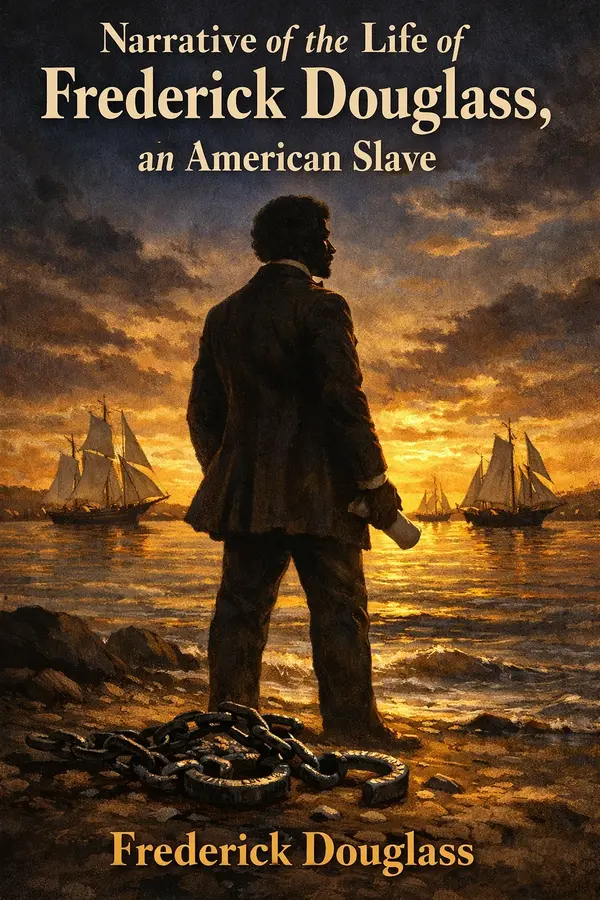
图书总体内容
Born into the darkness of slavery in Talbot County, Maryland, Frederick Douglass never knew his exact birth date — a deliberate cruelty of a system designed to strip its victims of identity, history, and humanity. His father was almost certainly a white man, likely his own master; his mother, Harriet Bailey, was taken from him in infancy, dying before he was old enough to know her. This is where the Narrative of the Life of Frederick Douglass begins: not with a name, but with an absence. As a child, Douglass witnessed the brutal whipping of his Aunt Hester by Captain Aaron Anthony — his first searing encounter with the raw violence that undergirded plantation life. He was later sent to Baltimore to live with Hugh and Sophia Auld, a transfer that would change his life forever. Sophia Auld, kind at first, began to teach him the alphabet — until her husband forbade it, declaring that literacy would make a slave unfit for his chains. That prohibition became Douglass's greatest motivation. Through cunning, persistence, and the help of poor white boys he befriended on the streets of Baltimore, he secretly taught himself to read and write, understanding at last that knowledge was the pathway to freedom. After the death of Captain Anthony, Douglass was returned to the plantation and eventually placed under the control of Thomas Auld, a cruel and hypocritically religious master. Thomas hired him out to Edward Covey, a notorious 'slave-breaker' — a man whose profession was to crush the spirit of resistant slaves through relentless labor and savage beatings. For months, Covey succeeded. Douglass was broken in body and nearly in soul. But one August day, when Covey attacked him again, Douglass fought back — a two-hour struggle that ended in a draw but ignited something permanent in him. He resolved: he would never be whipped again. The man had been reborn. He attempted an escape with a small group of fellow slaves while working on William Freeland's farm, but the plan was betrayed and the conspirators were jailed. Douglass was returned to Baltimore, where he was hired out to work in the shipyards. In September 1838, disguising himself as a free Black sailor and borrowing identification papers, he boarded a train and fled North — reaching New York, then settling in New Bedford, Massachusetts with his new wife, Anna Murray, a free Black woman who had helped fund his escape. In New Bedford, Douglass encountered William Lloyd Garrison and the abolitionist movement. At an anti-slavery convention on Nantucket in 1841, he rose to speak — hesitantly at first — and electrified the crowd with his testimony. His eloquence, bearing, and intellectual power shattered every prejudice in the room. He became a lecturer for the Massachusetts Anti-Slavery Society, traveling the North to bear witness against the institution that had owned him. The Narrative itself was published in 1845 as both a testimony and a dare — naming names, places, and dates so that his former masters could not dismiss it as fiction. It is a landmark of American autobiography, a document of resistance, and a masterwork of moral argument. Its central themes — the connection between literacy and liberation, the corruption of slaveholders by absolute power, the resilience of the human spirit, and the fundamental hypocrisy of a Christian nation built on bondage — remain as urgent today as when Douglass first set them down. The book does not merely recount suffering; it transforms suffering into an indictment, and an indictment into a call to action.
目录
书籍摘录
PREFACE
In the month of August, 1841, I attended an anti-slavery convention in Nantucket, at which it was my happiness to become acquainted with Frederick Douglass, the writer of the following Narrative. He was a stranger to nearly every member of that body; but, having recently made his escape from the southern prison-house of bondage, and feeling his curiosity excited to ascertain the principles and measures of the abolitionists,—of whom he had heard a somewhat vague description while he was a slave,—he was induced to give his attendance, on the occasion alluded to, though at that time a resident in New Bedford.
Fortunate, most fortunate occurrence!—fortunate for the millions of his manacled brethren, yet panting for deliverance from their awful thraldom!—fortunate for the cause of negro emancipation, and of universal liberty!—fortunate for the land of his birth, which he has already done so much to save and bless!—fortunate for a large circle of friends and acquaintances, whose sympathy and affection he has strongly secured by the many sufferings he has endured, by his virtuous traits of character, by his ever-abiding remembrance of those who are in bonds, as being bound with them!—fortunate for the multitudes, in various parts of our republic, whose minds he has enlightened on the subject of slavery, and who have been melted to tears by his pathos, or roused to virtuous indignation by his stirring eloquence against the enslavers of men!—fortunate for himself, as it at once brought him into the field of public usefulness, “gave the world assurance of a MAN,” quickened the slumbering energies of his soul, and consecrated him to the great work of breaking the rod of the oppressor, and letting the oppressed go free!
I shall never forget his first speech at the convention—the extraordinary emotion it excited in my own mind—the powerful impression it created upon a crowded auditory, completely taken by surprise—the applause which followed from the beginning to the end of his felicitous remarks. I think I never hated slavery so intensely as at that moment; certainly, my perception of the enormous outrage which is inflicted by it, on the godlike nature of its victims, was rendered far more clear than ever. There stood one, in physical proportion and stature commanding and exact—in intellect richly endowed—in natural eloquence a prodigy—in soul manifestly...
评论 (0)
暂无评论