ITALIAN FANTASIES
Предпросмотр книги
Автор
Israel Zangwill
Жанр
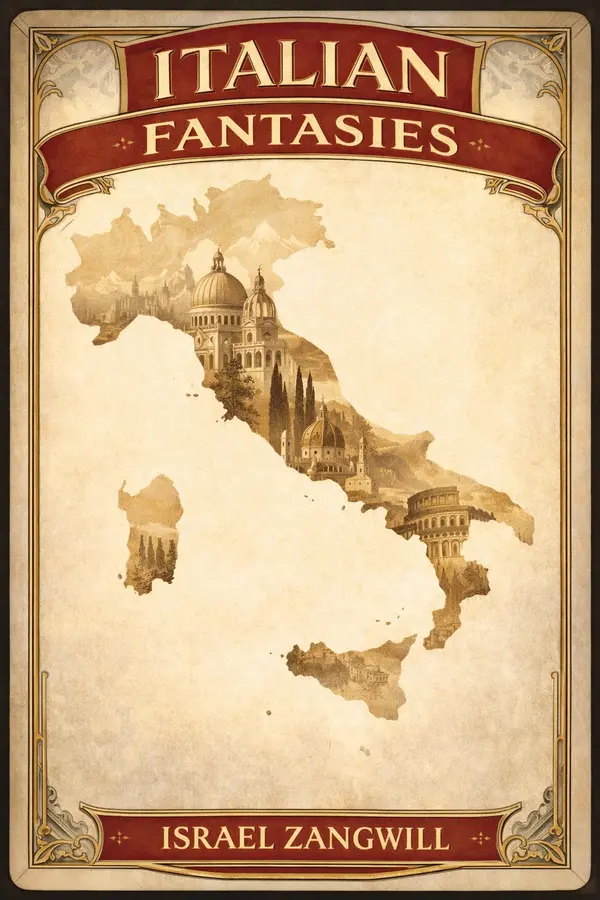
Обложка книги
Общее содержание книги
"Italian Fantasies" (1910) by Israel Zangwill is a collection of philosophical and literary essays inspired by the author's travels through Italy. Rather than a conventional travelogue, the book presents a series of meditative "fantasies" that use Italian art, religion, history, and landscape as springboards for profound reflections on faith, beauty, death, science, and human civilization. The work opens with a rhapsodic prelude celebrating Italy's natural beauty and artistic heritage, from the Alps to Naples, Venice to Florence. Zangwill moves between lyrical appreciation of Italian scenery and sharp philosophical critique, examining the tension between Pagan and Christian traditions, the persistence of Catholic devotion alongside modern skepticism, and the irony of institutional religion. A central fantasy, "The Carpenter's Wife," imaginatively transports the narrator to ancient Nazareth, where he encounters Mary (Miriam) and the Holy Family in their humble domestic setting, offering a humanizing portrayal of biblical figures that contrasts sharply with their later glorification. This capriccio explores how the simple Jewish mother became transformed through centuries into the magnificent Madonna of Catholic devotion. The essays range widely: from the Naples Aquarium as a meditation on evolution and design, to attacks on the "absurdity" of diminishing humanity's cosmic importance through astronomy, to critiques of empty religious practice versus genuine spiritual insight. Zangwill examines how institutions betray their founders (St. Francis), how history becomes myth (Lucrezia Borgia), and how art both reveals and obscures truth. Throughout, Zangwill displays his characteristic wit, erudition, and iconoclasm. He challenges both orthodox religion and reductive scientism, advocating instead for what he calls the "autocosm" - each person's inner universe of meaning - while acknowledging the claims of objective reality. The book is simultaneously a love letter to Italian culture and a philosophical meditation on the human condition, blending travel writing, art criticism, religious commentary, and metaphysical speculation into a unique literary form.
Содержание глав
Эта книга была рецензирована
Прочитать профессиональную рецензию на эту книгу
Отрывок из книги
AUTHOR’S NOTE
The germ of this book may be found in three essays under the same title published in “Harper’s Magazine” in 1903 and 1904, which had the inestimable advantage of being illustrated by the late Louis Loeb, “the joyous comrade” to whose dear memory this imperfect half of what was planned as a joint labour of love must now be dedicated.
I. Z.
ALL ROADS LEAD FROM ROME
OF BEAUTY, FAITH, AND DEATH: A RHAPSODY BY WAY OF PRELUDE
I too have crossed the Alps, and Hannibal himself had no such baggage of dreams and memories, such fife-and-drum of lyrics, such horns of ivory, such emblazoned standards and streamered gonfalons, flying and fluttering, such phalanxes of heroes, such visions of cities to spoil and riches to rifle—palace and temple, bust and picture, tapestry and mosaic. My elephants too matched his; my herds of mediæval histories, grotesque as his gargoyled beasts. Nor without fire and vinegar have I pierced my passage to these green pastures. “Ave Italia, regina terrarum!” I cried, as I kissed the hem of thy blue robe, starred with white cities.
There are who approach Italy by other portals, but these be the true gates of heaven, these purple peaks snow-flashing as they touch the stainless sky; scarred and riven with ancient fires, and young with jets of living water. Nature’s greatness prepares the heart for man’s glory.
I too have crossed the Rubicon, and Cæsar gathered no such booty. Gold and marble and sardonyx, lapis-lazuli, agate and alabaster, porphyry, jasper and bronze, these were the least of my spoils. I plucked at the mystery of the storied land and fulfilled my eyes of its loveliness and colour. I have seen the radiant raggedness of Naples as I squeezed in the squirming, wriggling ant-heap; at Paestum I have companied the lizard in the forsaken Temple of Poseidon. (O the soaring Pagan pillars, divinely Doric!) I have stood by the Leaning Tower in Bologna that gave a simile to Dante; and by the long low wall of Padua’s university, whence Portia borrowed her learned plumes, I have stayed to scan a placarded sonnet to a Doctor of Philology; I have walked along that delectable Riviera di Levante and left a footprint on those wind-swept sands where Shelley’s mortal elements found their fit resolution in flame. I have lain under Boccaccio’s olives, and caressed with my eye the curve of the distant Duomo and the winding silver of...
Готовы читать дальше?
Откройте для себя всю историю и все главы
Уже доступна в нашем интернет-магазине